More than a fifth of organophosphate use by pounds in California is concentrated in Monterey County
On May 12, 2026, members of the public and the coalition Safe Ag Safe Schools provided detailed information to the Monterey County Board of Supervisors about very high toxic pesticide use by the ag industry in Monterey County, school and neighborhood exposures, contamination of farmworkers, children, and the communities including Salinas, the cancer risk, and inaction by county Agriculture Commissioner Juan Hidalgo. This follows Safe Ag Safe Schools’s April 30 letter to Hidalgo about the organophosphate and fumigant threats (excerpts below).
Video of the hearing:
https://monterey.granicus.com/player/clip/6128?view_id=21&redirect=true
Public comments begin at 1:00:35, comments on pesticides begin at 1:07:22 (transcript of comments by Beverly Bean is below)
From the Agriculture Commissioner website:
California’s County Agricultural Commissioners serve as the primary local enforcement agents for State agricultural laws and regulations. State Law requires the Boards of Supervisors to appoint County Agricultural Commissioners in each of the state’s 58 counties…Today, Agricultural Commissioners have a unique and important role in the promotion of agriculture, farm worker health and safety, the protection environmental resources, and the assurance of a fair marketplace…
Among an Agricultural Commissioner’s most important responsibilities is the investigation of pesticide-related illnesses and injuries. All reported pesticide-related illnesses and injuries are investigated by the Commissioner and his staff in the county in which the illness occurred. If violations of pesticide law or regulations are found to have contributed to an illness, the Commissioner takes enforcement action.
Agricultural Commissioners work closely with the California Department of Food and Agriculture, the Department of Pesticide Regulation, state and regional water boards, state Departments of Industrial Relations and Health Services, the State Department of Forestry, and the State Department of Fish and Game to protect the health of the public and the environment.
Comments May 12 to the Monterey County Board of Supervisors by Beverly Bean:
Monterey County has some of the highest use of cancer-causing and lung-damaging fumigants in the state, and use has been growing around schools in the last 15 years. One-fifth of all the brain-harming organophosphate use in the state is concentrated in Monterey County.
Many fumigants are so dangerous that they are banned in dozens of countries. Chloropicrin and 1,3-D are both banned in over 40 countries. Chloropicrin is illegal on the battlefields. Chloropicrin is labeled a lung damaging agent by the US Government. We should not be risking the lungs of farmworker and farmworker communities by exposing them to this chemical.
At all six State pesticide air-monitors, the levels of 1,3-D in the air are at least double the lifetime cancer risk warning level set by cancer experts. And five of those air-monitors are on or near school grounds. The Ag Commissioner should not allow our children to be exposed to pesticides at unsafe, cancer-causing levels. We must reduce their use, especially near schools. Fumigants can travel for miles at harmful levels, but the school buffer zones are only ¼-mile.
Organophosphates were invented by the Nazis as weapons of war. California canceled chlorpyrifos in 2020, but more than a dozen related organophosphates remain in heavy use. The CHAMACOS study of women and their children in the Salinas Valley found that exposure to combined OPs — not just chlorpyrifos but ANY OP — are linked to brain harms, resulting in ADHD, learning disabilities, and lower IQ, among many other concerns. A recent peer-reviewed study found more than half of all births in Monterey County– the highest in the State — were to women living within one kilometer of organophosphate applications.
The Ag Commissioner is your employee and he works for the County. In a recent meeting, he refused to require Notices of Intent to apply organophosphates. This means even he does not know about organophosphate use before application. He refused to consider increasing the buffer zone from the current ¼ mile to one mile. He refused to work together with DPR to implement pilot projects to help fund the infilling of school buffer zones with organic farming. Children will be safer at schools surrounded by organic farms than conventional highly hazardous pesticide-using farms.
When California communities face undue harm or a disproportionate burden from pesticides, County Ag Commissioners can and must act to protect us.
So are you -the Board of Supervisors-going to step up and make this Ag Commissioner do his job to protect the public?
Beverly Bean
Salinas, Ca93908
References (and some text) from Safe Ag Safe Schools letter to Monterey County Ag Commissioner April 30, 2026 following their meeting on April 1, 2026:
Regarding fumigants, 82,856 pounds of cancer-causing 1,3-D and lung-damaging chloropicrin were applied in 2010 within ¼-mile of schools. This fumigant information was published in the 2014 Department of Public Health’s Agricultural Pesticide Use Near Public Schools in California.[1] That figure jumped to 123,048 pounds of the two combined fumigants in 2022 — a 49% increase.[2]
“Between 2018 and 2022, applications of 1,3-D fell by more than 20 percent statewide, but rose by more than 80 percent in Monterey, according to an analysis by Inside Climate News.”[3] In the most recently released DPR pesticide use reports, more than 3.4 million pounds of just three fumigants — 1,3-dichloropropene, chloropicrin, and metam-potassium — were applied in 2023 in Monterey County.[4]
With brain-harming organophosphates, we see the same disturbing pattern: use is down elsewhere but increasing in Monterey County. Between 2016 and 2021, according to a peer-reviewed study that included the UC Berkeley CHAMACOS researchers, organophosphate use decreased in California by 54% but increased in Monterey County by 26%.[5] In fact, more than a fifth of organophosphate use by pounds in California is concentrated in our county.
That same study found more than half of all births in Monterey County– the highest in the State — were to women living within one kilometer of organophosphate applications. That is the distance the quarter-Century-long longitudinal CHAMACOS study has found linked to numerous neurological and lung damages in Salinas Valley children.[6]
Two recent scientific studies have added to our understanding of and concern for the health-harming threats from organophosphate exposure. A study of Parkinson’s Disease found positive associations with fourteen organophosphates.[7] In another study[8], prenatal exposure to certain organophosphates had increased odds of low Apgar scores.[9]
Yet, when we asked you to merely require Notices of Intent to apply organophosphate pesticides, so that you could regulate their use more carefully, you refused, “Just to be candid and straightforward, based on the results from the [Pajaro] air-monitoring station, I don’t think that’s warranted at this point.” You claimed that at the DPR air monitor in Pajaro,
at this point, they haven’t found anything that is an alarm, based on their health screening levels that they have set up for these materials — I can feel confident in that [air-monitoring] data that they’re giving in Pajaro could be pretty comparable to what we might see in other parts of the county, because the commodities are basically the same for the area here.[10]
We were aghast. In our group’s discussion after the meeting, we were in disbelief that you argued that the air-monitor in Pajaro could tell us anything about conditions 30 miles away in Salinas and 60 from Greenfield, especially when the organophosphate application patterns are not similar.
Without the benefit of air-monitors, one way CHAMACOS researchers have estimated organophosphate exposure in the Salinas Valley is with application concentrations within a kilometer — how many pounds of organophosphates were applied within a one kilometer radius. The CHAMACOS team has found that for every 522 pounds of combined organophosphates applied within one kilometer of a pregnant mother, her child tended to lose 2.2 IQ points.[11] Using the same organophosphate concentration in weight by area, we can estimate similar threat levels with DPR’s pesticide use reports by Public Land Survey (PLS) sections, which are one square-mile. The map below, adjusted for all-year concentrations equal to the nine-month pregnancy concentrations found by CHAMACOS, demonstrates that the Salinas Valley organophosphate use, especially south of Salinas, is far higher than in the distant Pajaro Valley where the pesticide air-monitor is located.[12] Note that the red sections have organophosphate concentrations that correlate to between 2.2 and 4.1 point IQ losses, while the dark red squares are associated with IQ losses of at least 4.2 points.
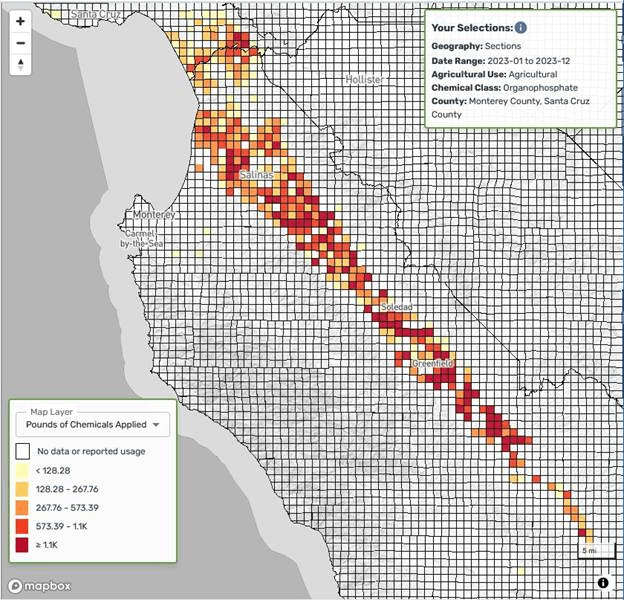
For a broader view, when comparing organophosphate use in larger six-mile square townships, the region in which the Ohlone Elementary air-monitor is stationed had 5,709 pounds in 2023, which was only the 14th highest township in the county (yet, still nearly twice the concentration CHAMACOS found associated with more than 2 point IQ losses in children). There were six townships south of Salinas with more than 17,850 pounds of organophosphate pesticides.[13] The amounts of organophosphates applied in the Pajaro Valley are awful; those applied in the Salinas Valley are even worse.
TABLE: Top 15 Monterey County Townships for Organophosphate use, 2023
| Meridian Township Range | Pounds of Organophosphates | Population | % Hispanic | % Non-Hispanic White |
| MDM T19S R07E | 25113 | 3457 | 93 | 5 |
| MDM T15S R04E | 23040 | 2218 | 82 | 12 |
| MDM T18S R07E | 21642 | 13989 | 93 | 4 |
| MDM T20S R08E | 19824 | 9792 | 87 | 7 |
| MDM T18S R06E | 18378 | 966 | 93 | 6 |
| MDM T14S R02E | 18096 | 21911 | 38 | 34 |
| MDM T16S R04E | 17851 | 3034 | 72 | 25 |
| MDM T15S R03E | 15304 | 15915 | 46 | 43 |
| MDM T17S R05E | 12978 | 10193 | 54 | 17 |
| MDM T16S R05E | 12699 | 2334 | 90 | 8 |
| MDM T14S R03E | 12598 | 149537 | 81 | 11 |
| MDM T17S R06E | 9298 | 16301 | 92 | 6 |
| MDM T13S R02E | 8175 | 18963 | 71 | 19 |
| MDM T12S R02E (Air Monitor at Ohlone Elementary) | 5709 | 45530 | 82 | 14 |
| MDM T19S R08E | 4935 | 687 | 85 | 13 |
Organophosphates and fumigants are used disproportionately in Monterey in comparison to other counties, and in terms of race, as the above table demonstrates with Hispanic versus Non-Hispanic White percentages in the highest organophosphate concentrated townships. In the Pajaro and Salinas Valleys, Monterey County residents face undue hazards from these pesticides.
Footnotes:
[1] https://www.phi.org/wp-content/uploads/migration/uploads/application/files/m0lvrkqvtqh6897 fl65fyegso0p8qqqudkrto9v13d6uiocq0r.pdf
[2] https://insideclimatenews.org/news/20122024/california-agricultural-toxic-pesticides-disproportionate-impact/
[3] https://insideclimatenews.org/news/20122024/california-agricultural-toxic-pesticides-disproportionate-impact/
[4] https://www.cdpr.ca.gov/wp-content/uploads/2025/08/2023_monterey_chemical.pdf
[5] Temporal trends of agricultural organophosphate pesticide use in California and proximity to pregnant people in 2021. BMC Public Health. 2025 Sep 30;25(1):3121. doi: 10.1186/s12889-025-23939-y. https://link.springer.com/article/10.1186/s12889-025-23939-y
[6] https://cerch.berkeley.edu/research-programs/chamacos-studies. For a summary and links to many of these studies see our October 24, 2023 letter to you https://www.pesticidereform.org/wp-content/uploads/2023/11/SASS_MontCAC_OPs_10-23.pdf
[7] Duration of agricultural pesticide exposure application and Parkinson’s disease in California’s central valley, Environ Res Health. 2026 Mar 1;4(1):015011. doi: 10.1088/2752-5309/ae4645.
[8] Residential proximity to agricultural pesticide exposures during preconception and pregnancy and associations with Apgar scores in the Az-PEAR study (2006-2020). Journal of Exposure Science & Environmental Epidemiology; https://doi.org/10.1038/s41370-026-00849-8.
[9] The Apgar score is a commonly used clinical metric for assessing neonatal health at one minute and five minutes after birth. The score evaluates five characteristics of the newborn: skin color, heart rate, reflexes, muscle tone, and breathing.
[10] Transcribed from video of the April 1, 2026 meeting from 11:49 to 21:11 at https://www.youtube.com/watch?v=COQzgNQq4kQ
[11]https://pmc.ncbi.nlm.nih.gov/articles/PMC5644974/
[12]The map is generated from the California People and Pesticides Explorer that uses DPR pesticide use report data at https://www.pesticideinfo.org/pesticide-maps/ca-pesticide-map/. CHAMACOS’ 522 organophosphate pounds/1 kilometer radius over 9 months is equal to 430 pounds/Square mile/9months. Given the pesticide use reports cover 12 months, the conversion with the same organophosphate ratio is 574 pounds/ square mile/12 months.
[13] https://www.pesticideinfo.org/pesticide-maps/ca-pesticide-map/ The highest was Township MDM T19S R07E on the southern part of Greenfield at 25,113 pounds. The average per square mile in that Township is 4,186 pounds, which is associated with a 16 point IQ loss in children born in this 6-mile square region.

