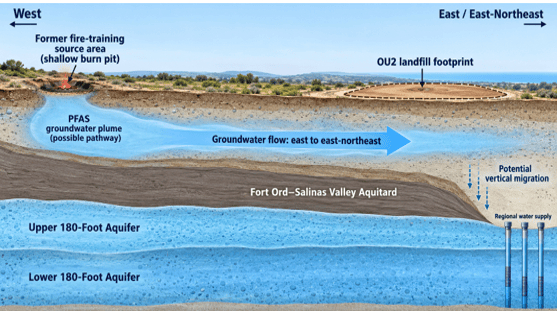
On July 9, 2026, the Agency for Toxic Substances and Disease Registry (ATSDR) released a draft report for public comment titled Health evaluation of drinking water at the Former Fort Ord Army Base from 1985 to 1994.
ATSDR scientists will discuss the overall findings of the report with the community at a virtual public meeting on July 29, 2026, from 6:30 p.m. – 7:30 p.m. ET [3:30 – 4:30 PT) on Microsoft Teams. Questions about the report may be emailed ahead of the meeting to ATSDRCDCINFO@cdc.gov. Please use “Fort Ord” in the subject line. Questions received by 8 PM ET on July 28, 2026, will be addressed during the public meeting.
ATSDR will accept public comments on the report through August 22, 2026. Comments may be submitted by email (received by August 22) or by postal mail (postmarked by August 22) using the contact information below.
Email: OCHHAPublicComment@cdc.gov
Postal mail: Agency for Toxic Substances and Disease Registry Attn: Records Center 4770 Buford Highway NE, MS S106-5 Atlanta, Georgia 30341
On May 1, 2025, President Trump established the Religious Liberty Commission within the U.S. Department of Justice to “identify emerging threats to religious liberty, uphold Federal laws that protect all citizens’ full participation in a pluralistic democracy, and protect the free exercise of religion.” [1] The Commission’s membership consists of Christians and one orthodox Jew.
The Commission released a draft report entitled “America’s First Freedom” on June 26, 2026. It is seeking to eliminate the separation of church and state doctrine. This would affect schools, city, county, and state governments and agencies, and every part of each community.
UPDATE: Reps. Huffman and Raskin introduced a resolution July 1 reaffirming church-state separation.
Public comment on the report is due July 13 (see below)
“At an Oval Office news conference announcing the report, commission Chairman Dan Patrick, the Republican lieutenant governor of Texas, said the commission recommends that any official — in government, a school, the military, a hospital, etc. — who alleges a violation of church-state separation must in writing point out exactly where you have violated the Constitution, because you have not, and from this day forward, that phrase should have no power over people of all faiths ever again in America.‘”
First in its “12 Key Recommendations to Strengthen Religious Liberty for All Americans”: “1. Instruct the Department of Justice to issue guidance clarifying the proper understanding of the Establishment Clause and separation of church and state.”
The deadline for public comment is Tuesday, July 13. Email comments to RLC@usdoj.gov Commission instructions: format the email subject line using: PUBLIC COMMENT – [TOPIC OR CHAPTER NUMBER] – [NAME]. (Note: there is no docket number or online docket)
Information about the Commission documents, hearings, and records of public comments is at this DOJ page.
Chapter 1 is titled: “Religion as an Indispensable Support” and includes sections titled “Religion: An Essential Aspect of What It Means to be Human” and “Religion: The Benefits for Society”.
There are many different religions and belief systems held by Americans, as well as many Americans do not have religious beliefs. The intent of the separation doctrine has been to protect everyone from having the religious beliefs of one religion or another legislated on them. Governing structures and areas of public life have previously attempted to be neutral spaces.
– What could “free exercise” look like? For instance, should government and agency staff be allowed to promote their beliefs verbally and nonverbally during their taxpayer-subsidized work hours?
– In light of the composition and religious beliefs of the Commission, will groups and members of certain religions get preferential treatment in jobs, government agency appointments, educational institutions, and the ability to freely exercise their religion over other groups and religions?
– What happens when religious practices conflict with local, state, or federal laws, including civil rights laws or criminal laws? Will laws be re-interpreted or new ones enacted that accommodate, promote, or favor some religious practices but not others?
This is an extensive report covering many different topics, including freedom of conscience. It deserves a full and detailed analysis and discussion by the public and Constitutional, legal, and historical experts.
Notes:
Presidential Religious Liberty Commission Press Release and Summary Report, U.S. Department of Justice, June 26, 2026, p. 1
[1] Presidential Religious Liberty Commission Draft Report, U.S. Department of Justice, June 26, 2026, p. 25
The article may be incorrect. The FCC policy states that if customers oppose the discontinuance ((the deadline for those dockets 26-120 and 26-121 was June 15), the FCC will do a review. Many people did oppose discontinuance. The FCC also has not posted this information. The newspaper and reporter have been questioned about this information, and an update will be posted when they respond. The grandfathering information below from Save Landlines is based on the newspaper’s article, and everyone who wants a landline should order one now.
AT&T is grandfathering landline service for the affected customers on July 19th – we encourage you to order one NOW. Call AT&T at 1-800-288-2020. If they refuse, escalate to the AT&T Presidents Office at 1-800-355-9542 and file a complaint with the CPUC Consumer Affairs Branch at 1-800-649-7570.
The remaining FCC dockets 26-123 and 26-125 with deadlines are AT&T petitions to preempt California rules, CPUC regulation, and Carrier of Last Resort status, and to discontinue ETC services including Lifeline service.
From Save Landlines
LANDLINES THREATENED NATIONWIDE!
CRITICAL AND URGENT: COMMENTS DUE TO FCC BY THIS TUESDAY, JULY 7!
AT&T has filed petitions with the FCC to bypass the CPUC and disconnect customers in California, grandfathering service on July 19 and discontinuing on/after June 1, 2027. They have also sued the CPUC and CA Attorney General and are pushing a constitutional amendment to deregulate telecom.
AT&T claims “alternatives” are available to everyone; however, this is not true, and even when “alternatives” exist, they are not functionally equivalent. VoIP and wireless require backup batteries, which are insufficient in extended power outages or during disasters and rely on broadband or cellular, which are less reliable, poorer quality, and more prone to disruptions. Wireless is not accessible to many with disabilities and actual reception does not always match coverage maps. Traditional landlines are the only reliable way to reach 911 for many people. This is a national public safety issue – we need to raise our voices loud and clear: landlines are lifelines!
Submit opposition comments to the FCC opposing FCC preemption and AT&T withdrawing from Lifeline: submit a text comment (or upload a PDF of your comments). Include proceedings 26-123 and 26-125 on your comments, the dockets for AT&T’s California petitions.
COMMENTS DUE July 7 for 26-123 (ETC and Lifeline)/26-125 (FCC preemption of COLR).
Explain why “alternatives” are not as reliable for you. “The FCC will authorize discontinuance of service… …unless it is shown that customers would be unable to receive service or a reasonable substitute from another carrier or that public convenience and needs are otherwise adversely affected… Comments should include specific information about the impact of this proposed discontinuance (or reduction or impairment) upon you, or your business, including any inability to acquire reasonable substitute service.”
Caltrans District 5, in collaboration with local partners, is updating the Coast Highway Management Plan (CHMP) for Highway 1 through Big Sur, and your input is essential.
The CHMP serves as the long-term guide for how Highway 1 is managed and maintained, addressing issues like safety, landslides, erosion, accessibility, and preserving Big Sur’s extraordinary coastal landscape.
Whether you live, work, or travel along this corridor, your feedback will help shape decisions that impact the future of Highway 1 for years to come. The survey is open to residents, businesses, commuters, and visitors, but time is running out. The survey closes at the end of June.
Friday 2-3 PM: KSCO Radio’s “Community Matters” guest Ms. Phoenix Artemesia, organizer of the public meeting this Sunday (2:30pm) in Pinto Lake City Park to inform people about the large Battery Energy Storage System (BESS) project proposed for 90 Minto Road in Watsonville. Join the conversation tomorrow as Phoenix discusses the event and BESS issues. Phoenix and others have worked hard to arrange for many informed speakers, including the Executive Director of the California Energy Commission (CEC), Mr. Drew Bohan, to attend this public meeting, organized by a grassroots group to inform people about the status of the Project. The Project developers, New Leaf Energy / Sequoia Energy LLC applied in May for Opt-In Certification with the CEC. Although the County will not be making the decision about whether to permit the Project or not, local opinion will carry great weight with the CEC staff in their deliberation.
Attend Sunday’s June 28 free event at Pinto Lake City Park at 2:30pm in the large gazebo near the Green Valley Road entrance. Spanish translation will be available.
Friday 6 PM: “Bratton on KSCO” Radio program will feature Guests Dr. Don Smith, UCSC Environmental Toxicologist, and Mr. Brian Roeder, representing “Never Again Moss Landing”
On January 16, 2025, the large Vistra Battery Energy Storage System (BESS) facility at Moss Landing had a thermal runaway problem that led to a massive fire lasting for days, erupting again in February. What was in that smoke plume that traveled around the area? Did the air that people breathed in the plume area include heavy metal contaminants? Dr. Don Smith conducted a hair analysis study with more than 60 volunteers living in the Moss Landing area. He and Mr. Roeder discuss the investigation results.
In related action, during their June 30 meeting, the County Board of Supervisors will again review the County’s Draft BESS Ordinance that outlines permitting requirements for large BESS projects like that proposed for 90 Minto Road, and includes a site near Aptos High School.
Update 7/2/26: Last week, one Santa Cruz County Supervisor’s office repeatedly reached out to PG&E for information on the project, but to date, PG&E has not responded to this county official.
– – – – – – – – – – – –
In a PG&E press release dated May 29, 2026, the company announced a “major power system upgrade” to south Santa Cruz County. PG&E will increase electrical capacity from 4 kV to 21 kV, and install higher capacity electrical cables above and below ground, transformers, and other equipment.
But in a notice to customers June 10, 2026 (p. 1, p. 2), PG&E gave no information on the planned changes, saying only that the company was replacing utility poles.
These upgrades appear to be linked to new battery energy storage (BESS) facilities planned near Watsonville on farmland and near a bird refuge, and another one next to Aptos High School, despite public objections.
All of this will come at an environmental price. And those who live near this equipment will be exposed to higher levels of EMF, which can cause health problems including leukemia.
The hazards of BESS and lack of public protections have been in sharp focus since the fires at the Moss Landing BESS in January and February 2024.
In Santa Clara County, some Gilroy residents found out about a permitted Amazon data center only after it started construction due a secretive permitting process that doesn’t involve the public. NBC Bay Area reports: “A data center is a facility the city can approve for its industrial zone by the city’s community development director rather than through a public City Council process.” A city council meeting June 15 will consider how these type of permits are granted.
Meanwhile, in Monterey Park near Los Angeles, voters approved a ban on data centers after the city council placed it on the ballot, following public input.
Erin Brockovich has taken this on as a focus area with a new website studying and tracking data centers.
A coalition of Wisconsin organizations has provided a data center toolkit called Big Tech Unchecked.
Industry groups aren’t taking this lightly. An pro-data center editorial appeared in the Monterey Herald this weekend and in other California newspapers, purportedly from a “watchdog” group. Unfortunately, the group has long been associated with the tobacco industry and is an arm of the pro-business Atlas Network.
Given all the significant issues around these data centers including high energy use leading to increased electric bills for the public, extremely high water use impacting aquifers, pollution, noise, impact on farmland, use in surveillance, and health effects, Monterey Park’s action is a wise step for every community. The money and lobbying influence from giant corporations like Amazon is difficult for politicians to resist, regardless of the impacts.
Will the Monterey Bay region counties and cities to emulate Monterey Park leaders? Or will this region’s leaders allow its land, air, water, and electric grid to be compromised by data/surveillance centers?
Comment deadline: Friday, June 5 EPA Docket No. EPA-HQ-OPP-2025-3951
Experimental use permit for Google to release 64 million bacteria-infected mosquitoes in California and Florida
The EPA opened public comments May 6 but provided no public notice in Monterey County newspapers, despite the potentially serious health and environmental impacts.
The public comment must be extended for minimum30-45 days, afternotice has first been posted in area newspapers by the EPA, paid for by Google.
This experiment could:
— Create more resistant, stronger mosquitoes — Disrupt a vital food source for bats, birds, and fish which could cause devastating effects — Cause illness and death to wildlife which consumed these mosquitoes — Cause severe disruption and harm to the entire ecosystem — Cause damage to agriculture — Cause illness or death in humans bit by these mosquitoes
The docket even fails to state the locations where these engineered insects will be released.
The state of California and the US government has conducted many experiments on nature and humans, claiming that these would have no damaging effect. Sometimes these experiments have been secret and only discovered years later.
The EPA has come under intense criticism for its suppression of information and acting against the public interest in East Palestine, the Fukushima disaster, and most recently, at the Moss Landing Battery Storage fires, where they used inappropriate sampling methods which diluted toxins, with the results that they found no significant exposure [see Moss Landing Monterey County Board of Supervisors hearing 3/17/26 under the Energy/Utilities tab]
There has been significant opposition to ACA-9 (see below). As a result, the author pulled it from this legislative session, but the author plans to return with it next year. In addition, comment deadlines for FCC dockets 26-123 and 26-125 have been extended.
Action Alert:
Copperline landlines are essential infrastructure. They work in power outages and in most disasters; the lines are powered, including making your phone ring, so you can reach 911 and your doctor, receive evacuation notices, stay connected to elderly and ill loved ones, and have others connect to you. This stellar service provides pinpoint location data to emergency responders when seconds count – a house invasion, a fire, someone is choking, has a heart attack, or stroke. Historically, the phone network was so reliable it was said to have “five nines” reliability — 99.999% reliable– meaning you had a dial tone for all but 5 minutes per year on average. The voice quality is superior, it’s secure, and it doesn’t drop calls. The lines also provide DSL internet. Plus, Carrier of Last Resort (COLR) status requires AT&T to provide service to everyone who asks without discrimination.
VoIP and wireless require batteries. When the battery dies, there is no connection. They have problems with reliability. They are not available everywhere or are not consistently available. Wireless devices including wireless VoIP have health and safety problems.
Lifeline is a special program for that subsidizes low income customers.
Critical Deadlines
June 2, 12:00pm PDT – Opposition statements due to CA Senate Energy, Utilities and Communications Committee on Assembly Constitutional Amendment 9
June 3, 3:30pm PDT – Opposition statements due to CA Senate Elections and Constitutional Amendments Committee on Assembly Constitutional Amendment 9
June 15 – Comment deadline for FCC dockets 26-120 and 26-121
Extended to July 7 – Comment deadline for FCC dockets 26-123 and 26-125; July 22 Reply Comment deadline
AT&T petitions to discontinue landline and Lifeline – 26-120, 26-121, 26-123, 26-125
AT&T filed the following petitions to the FCC to eliminate landlines and Lifeline in areas of California including in the Monterey Bay region. These petitions will be automatically granted if there is no opposition.
Deadlines for filing comments/opposition: June 15 and 22, 2026 July 7 and 22, 2026 — WC Docket 26-123, 26-125
Be sure to put the docket number and the Comp. Pol. File No. on your comments for 26-120 and 26-121.
Because the FCC streamlined the process to allow carriers to discontinue landline service as part of a “technology transition”, these requests are automatically grantedin most cases. Filing oppositions is the only way to protest AT&T discontinuance plans; it stops the FCC from automatically granting the applications. If they receive opposition, the FCC will remove AT&T’s application from “streamlining” and perform a review.
These applications contain the notice mailed 5/20 to customers.
Filing Oppositions or Comments is not difficult. To submit them to the FCC, you can prepare a letter and upload it (ECFS Standard Filing) or type/paste a comment into ECFS Express Filing.
Instructions for the longer Standard Filing form: Proceeding: Start typing the docket number such as 26-123 and the docket title will pop up . Click on the title and it will fill in the docket name. Fill in starred lines. Type of Filing: Click on the box and choose Comment or Opposition (the FCC says either category is okay) Address of: Click on box and choose whichever is correct Fill out remaining red starred items. Upload your document(s). Click in yellow box. Click blue “Continue to Review Screen” and submit from there.
Postponed until 2027 Assembly Constitutional Amendment 9 (ACA-9) (Boerner)
ACA-9 would eliminate key CPUC regulatory functions over utilities, remove telecom companies from being considered public utilities and remove them from CPUC regulatory oversight in the California Constitution, and create a new expensive agency for broadband and telecom. https://leginfo.legislature.ca.gov/faces/billNavClient.xhtml?bill_id=202520260ACA9
Senate hearings start June 8June 9; deadlines begin this week to submit position letters of protest. Each committee gives the deadlines for submitting position letters before each hearing. The current bill may be amended. If amended, the committees will only accept letters that are based on the most recent version. Check the link above for any amendments.
1) CANCELLED Senate Energy, Utilities and Communications Committee hearing June 8. Opposition statements must be sent in by June 2 at noon. https://seuc.senate.ca.gov/committeehome
2 CANCELLED Elections and Constitutional Amendments Committee hearing June 9, 9:30 AM.
The Senate Energy, Utilities and Communications analysis is the most thorough review of questions and issues with ACA-9. After the hearing was cancelled, it was taken down from the Senate website, presumably because the bill might be amended. You can read it here.
Contact senators, particularly those on the committees and educate them. Constitutional amendments require a 2/3 vote to pass.
CPUC R.24-06-012 docket on COLR and telephone service
AT&T has requested to eliminate its COLR obligations. The CPUC is in its final stages of reviewing COLR rules to set new rules or possibly discontinue all or most Carriers of Last Resort (COLR) in California. COLR means that these companies are required to provide basic phone service to all who request it. That service has meant landlines.
If AT&T’s COLR designation is eliminated, there will be no protection for the public because there are no functionally equivalent alternatives to the traditional landline phones, especially in rural and remote areas, but also in urban areas. “Reception” is not an issue for landlines, but it is a problem for wireless systems. Fiber isn’t available in many places, and those systems must have batteries. Non-COLR companies cannot be compelled to offer service to an applicant or offer landline service. Many people may have no coverage at all if AT&T and others decommission copper service, and that also includes those disabled by electromagnetic sensitivity and other EMF-sensitive disabilities who cannot tolerate wireless exposure.
The CPUC Staff Proposal proposes eliminating critical service elements of basic voice service, allowing carriers to more easily fulfill their COLR obligations via alternative services instead of copper. The proposal also significantly de-emphasizes voice and shifts to focusing on broadband connectivity instead.
Submit public comments by clicking the Public Comments tab at the top o the Docket page, and then clicking “Submit Public Comment”. Document files can also be emailed to public.advisor@cpuc.ca.gov
Consumer parties include EMF Safety Network, TURN, Center for Accessible Technology, Rural County Representatives of California, and the Public Advocates Office at the CPUC (Cal Advocates). Their comments provide information on some of the important issues and considerations.
The proceeding began in 2024 and a proposed decision is expected at any time. The judge just issued a ruling to AT&T to clarify contradictory statements.
Call the California Attorney General 1-800-952-5225 (916-210-6276 out of state) Press 1 for English or 2 for Spanish, then press 7 to leave a message for the Attorney General. For example: I am asking the attorney general to defend the rights of hundreds of thousands of Californians to reliable phone service by challenging AT&T’s petition to disconnect 200,000 customers and also fight AT&T’s lawsuit against you and the CPUC. The alternatives that AT&T claims are sufficient are inferior and inadequate (and not even functional everywhere), and if AT&T wins this lawsuit, thousands of Californians may never have reliable phone service again, so we need you to make this issue a top priority. Please also challenge the FCC order asserting preemption of state rules like COLR.
–
Extensive information is available on these and other landline dockets in the United States at https://phreaknet.org/action
More than a fifth of organophosphate use by pounds in California is concentrated in Monterey County
On May 12, 2026, members of the public and the coalition Safe Ag Safe Schools provided detailed information to the Monterey County Board of Supervisors about very high toxic pesticide use by the ag industry in Monterey County, school and neighborhood exposures, contamination of farmworkers, children, and the communities including Salinas, the cancer risk, and inaction by county Agriculture Commissioner Juan Hidalgo. This follows Safe Ag Safe Schools’s April 30 letter to Hidalgo about the organophosphate and fumigant threats (excerpts below).