California’s Office of Environmental Health Hazard Assessment established a strict advisory Public Health Goal (PHG) of 0.2 µg/L for lead in drinking water. This health-based benchmark was calculated specifically to safeguard against permanent neurobehavioral deficits, central nervous system damage, and measurable IQ loss. Yet, every single first-draw sample registered inside the campus Dining Commons vastly exceeds this health protective measure.
From Military Poisons
By Pat Elder
November 4, 2026
California State University Monterey Bay (CSUMB) is actively exposing students, faculty, and staff to dangerous levels of lead contamination in drinking water across campus, including at the main Dining Commons. The university is hiding behind outdated federal compliance limits rather than science-based standards that protect public health. The university is located on the grounds of the former Fort Ord.
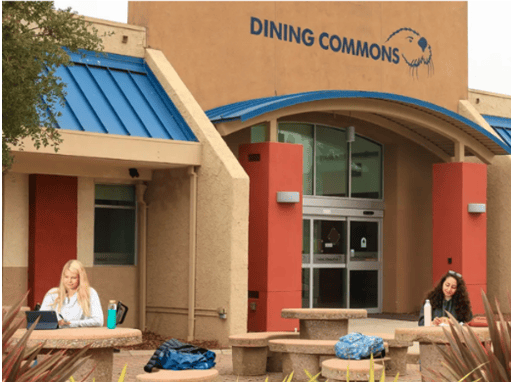
Bottled water? Or the water from the Dining Commons?
Toxic Water in the Cafeteria
While the university community has grown accustomed to the complex environmental reality of living and working on a converted military base, a systemic failure to address contaminated infrastructure inside campus walls and plumbing fixtures has turned daily routines like eating breakfast, attending class, or sleeping in a dorm room into pathways for chronic heavy metal exposure.
Students and faculty understand that CSUMB’s physical footprint sits directly over the historic Fort Ord Army base, where many core structural buildings were constructed by the military in the mid-20th century. The university community has long navigated unsettling reports of base-wide toxicity, from groundwater contamination to clusters of cancer diagnoses within the local population. Yet, while attention has focused on external environmental cleanups, a severe health hazard remains completely unaddressed inside the campus plumbing infrastructure.
See the entire CSUMB database here.
See the Snapshot of Lead levels in CSUMB Drinking Water here.
Understanding the Data
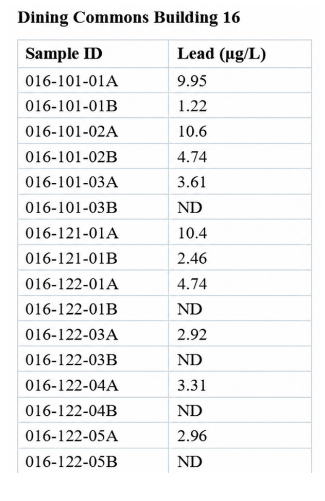
Data Code Note: In the sample codes here, 016 represents Building 16; 101, 121, and 122 represent specific rooms; 01/02 indicates the fixture location; and A/B designates the sample type. All results are measured in micrograms per liter [µg/L], equivalent to parts per billion [ppb].
Recent environmental testing within the Dining Commons—where hundreds of students consume water during breakfast, lunch, and dinner—reveals alarming concentrations of lead. Out of approximately 45 water fixtures in the facility, testing was conducted at 8 distinct locations. This represents a 17.8% sample size, and the data paints a troubling picture of localized contamination. To fully comprehend the systemic risks behind these numbers, one must examine the specific laboratory testing protocols:
“A” Samples (First Draw): These 250 mL samples are taken immediately after a tap has sat completely stagnant and unused for 6 to 18 hours. (EPA Sampling Protocol). This metric captures the heavy metals leaching directly out of the immediate faucet fixture and internal brass components. Taps installed across campus have historically utilized high-lead brass components, containing up to 8% lead prior to stricter 2014 standards, meaning anyone taking a drink first thing on a Monday morning receives a concentrated dose of toxins. In the Dining Commons, 3 out of 8 “A” samples exceeded 5 µg/L, with two spikes climbing over 10 µg/L (peaking at 10.6 µg/L at fixture 016-101-02A).
“B” Samples (Flushed Loop): These sequential samples are collected after letting the water run continuously for 30 seconds. This process flushes out the isolated contamination sitting within the faucet head and pulls water directly from the building’s internal branch piping and vertical supply lines. The seriousness of these “B” sample readings cannot be overstated. While an elevated “A” sample isolates a bad faucet fixture, a measurable “B” sample demonstrates that the deeper plumbing lines embedded inside the building are also actively leaching heavy metals. In the Dining Commons, flushed “B” samples returned concentrations as high as 4.74 µg/L. This indicates that even after running a tap, the water remains impacted by lead, pointing to legacy Army-era plumbing lines as the likely culprit.
Continue reading “– Cal State University Monterey Bay is exposing students to dangerous levels of lead in drinking water”
